Chris Schubert · SydneyPick up anything with a label
Sydney
I'm Chris. I build AI systems that do the work, then keep the judgement human.
I lead product at Acorn in Sydney, where I've been building an AI-native way of working for the product team. I build the same kinds of things at home, and those are the ones I can show you.
If you're working out how you can get AI doing real work for you, or you've got a business idea and want to explore where AI fits, I'd love to help. It doesn't need to be fully formed. Half-formed ideas usually make the better conversation, and they're the ones I get the most out of, because I learn as much as I help.
Ivy's Cat Routine
Every school night
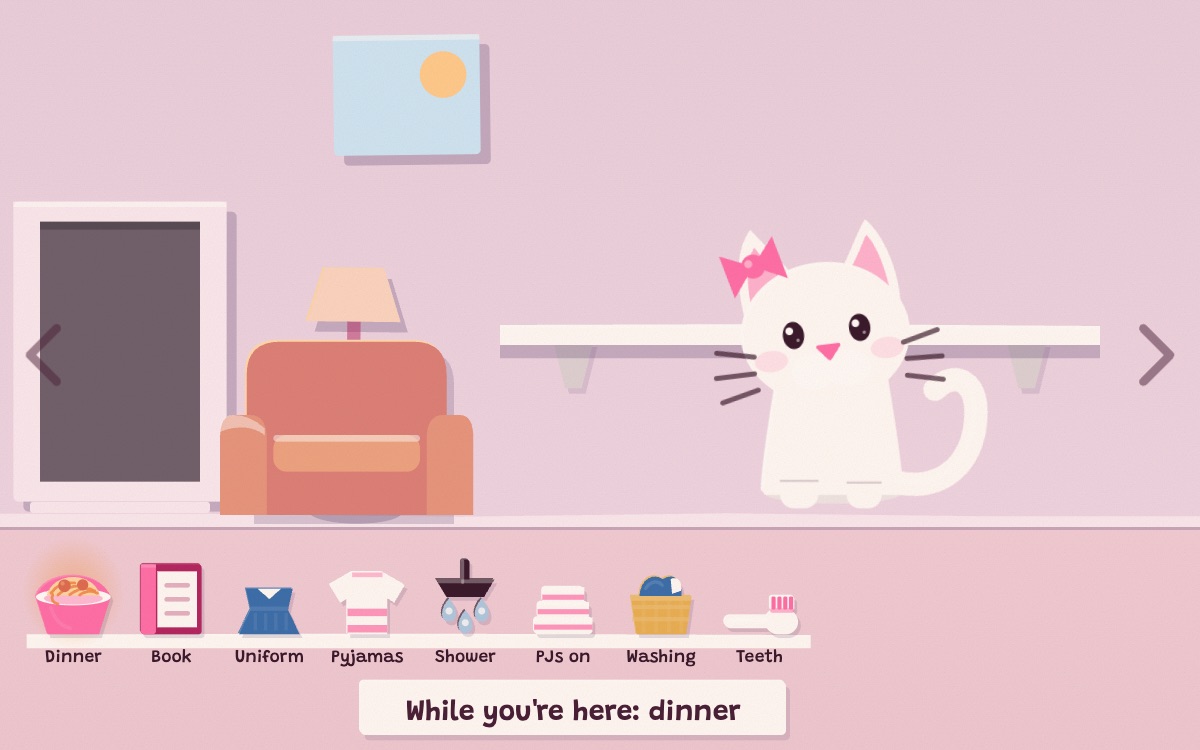
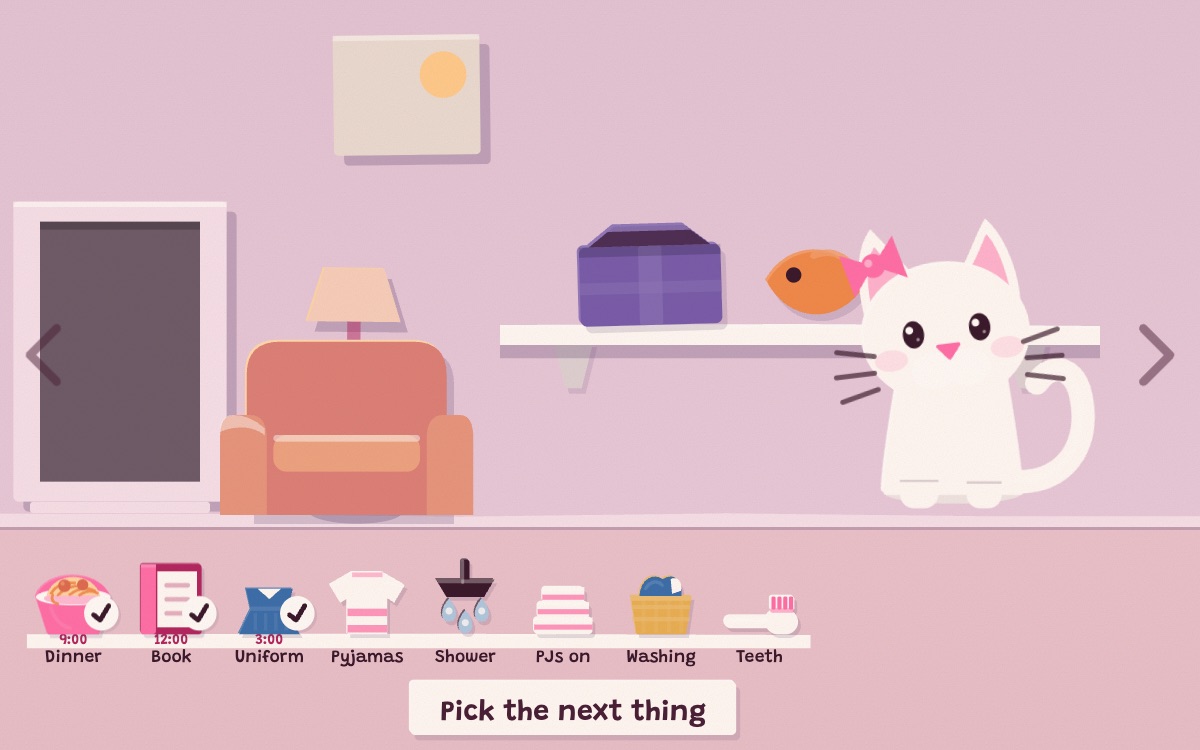
6:22pmEight jobs on the ledge, nothing on the shelf yet, and Tilly waiting.
6:22pm7:30 doorBedtime
Drag through her evening. Tap the screen to enlarge it.
6:22pm
Read the story of Ivy's evening
Built with Ivy, for Ivy
Ivy and I built something to say “right, next one”, so I don't have to
For a long time I was the thing that moved her from one job to the next, calling “right, next one” from wherever I was, usually while I was getting her little brother Zack fed and settled. So we built a routine that does the calling instead. It runs on an old tablet, and a cat called Tilly lives in the rooms.
Keep scrolling and the evening goes with you.
6:22pm
Ivy is six, and a school night has eight jobs in it: dinner, her book, uniform out, pyjamas out, shower, pyjamas on, washing and teeth. This is the lounge before any of them, with the jobs on the ledge and nothing on the shelf yet.
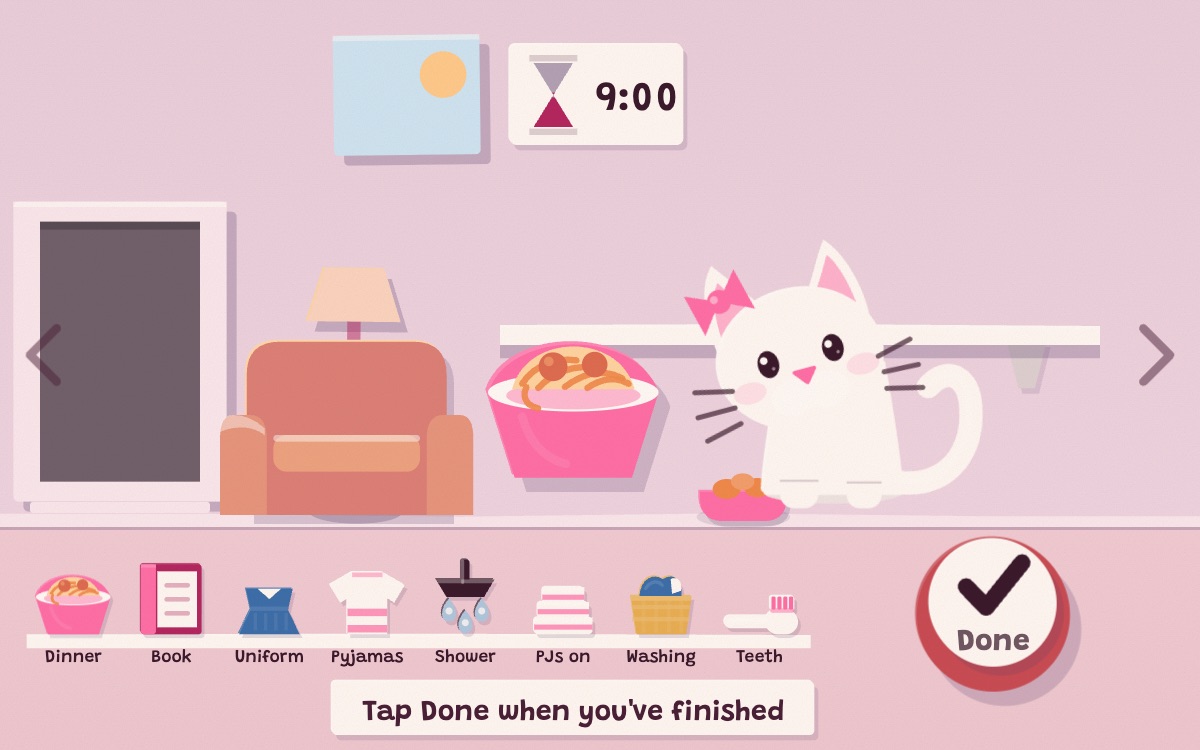
Dinner
Dinner is one of the long jobs, so nothing asks her for anything while she eats. Tilly just has her own dinner alongside.
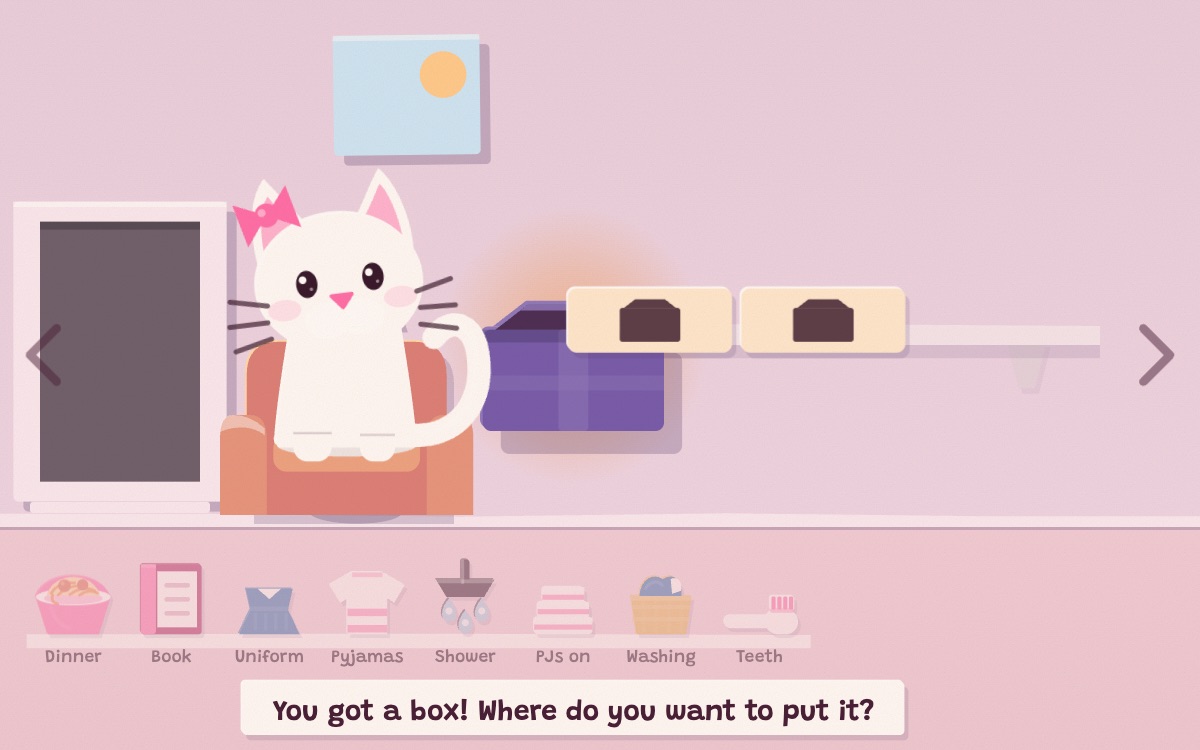
Dinner, done
Every finished job earns a small thing, a box or a fish or a crown, and she decides where it goes on the shelf. Nothing is announced ahead of time and there's no grey outline of what she hasn't got yet; it just turns up.
7:21pm
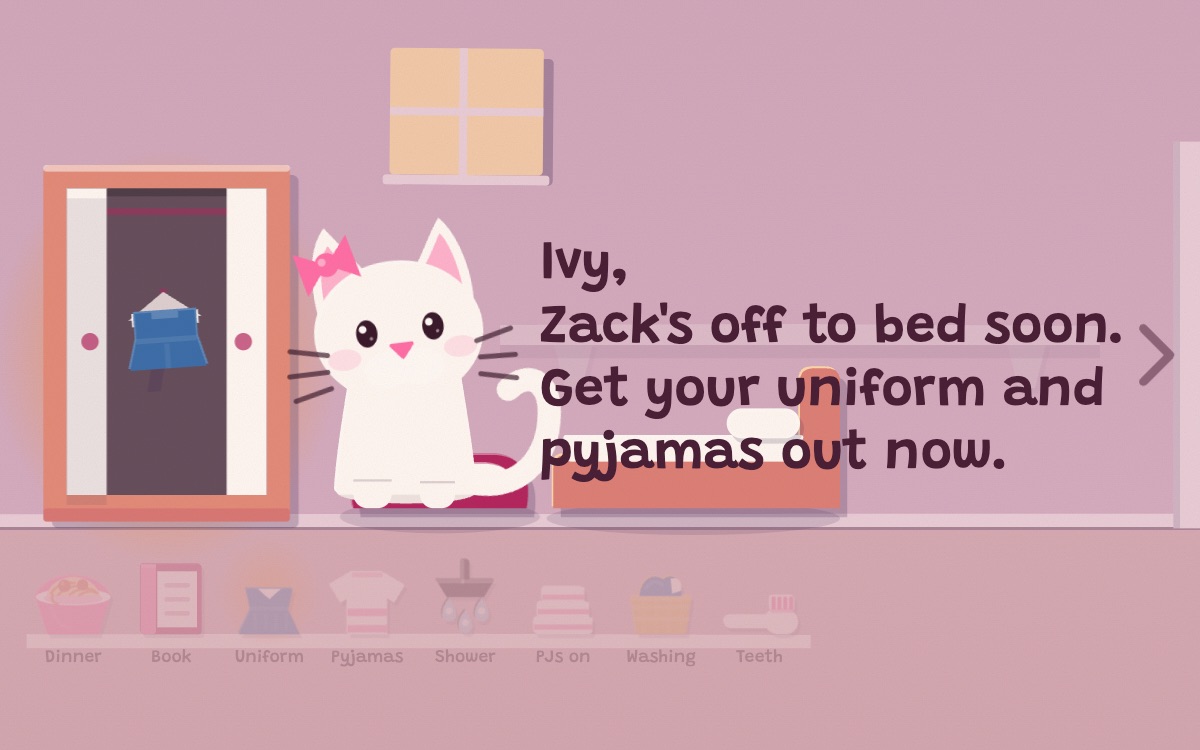
The one real deadline. Zack goes to sleep in the bedroom at 7:30, so her uniform and pyjamas have to be out before then. The wardrobe starts closing at 7:15, and at 7:20 it tells her straight, with her name and the reason. It's the one place the app is blunt, because that's the job she forgets.
7:15 closing7:20 says why7:30 shut
Three down
If she stalls, it tries a different nudge rather than a louder one, and after a few minutes it stops and asks her to go and find a grown-up. Something that nags forever gets tuned out faster than I do.
Tilly
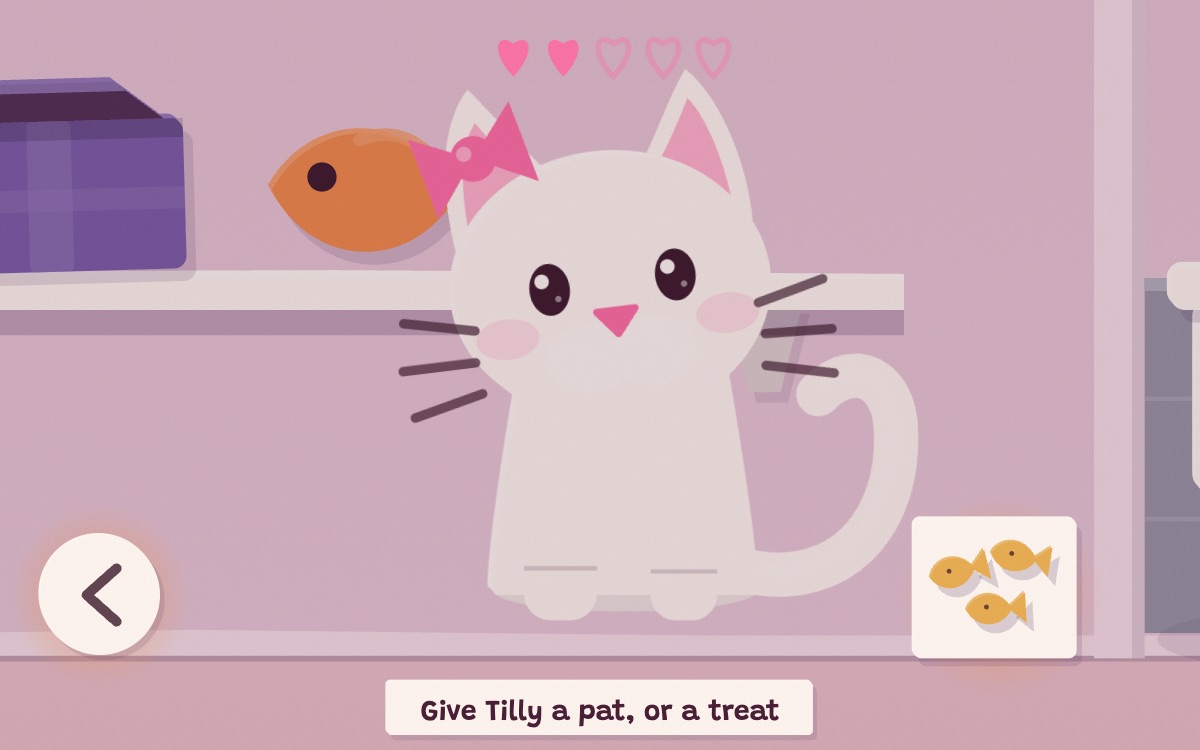
In the close-up she can give Tilly a pat or a treat, and the five hearts only ever fill. It's a prompting machine with a game attached, not a game with chores in it, and that line settled most of the design.
Shower
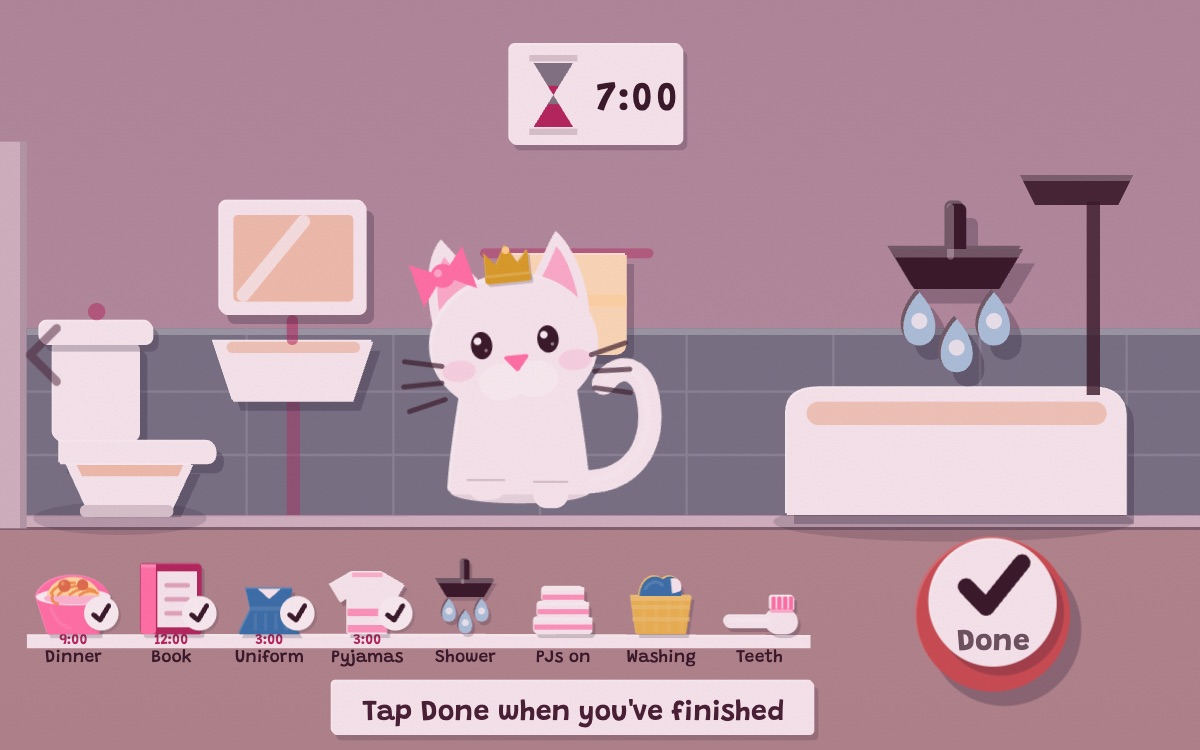
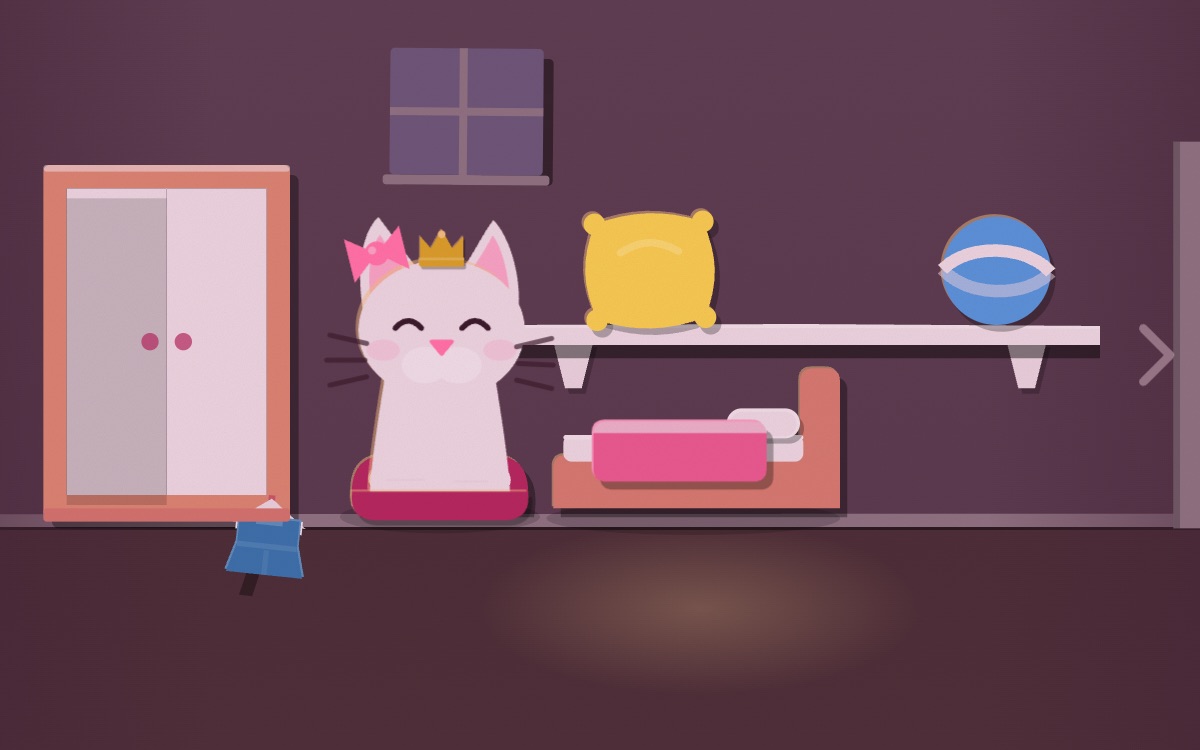
Tilly wears what Ivy earns, which is why she's in the bathroom with a crown on. The rooms dim in seven steps from six o'clock, so the screen winds down with the evening and is nearly dark by bedtime.
8:15pm
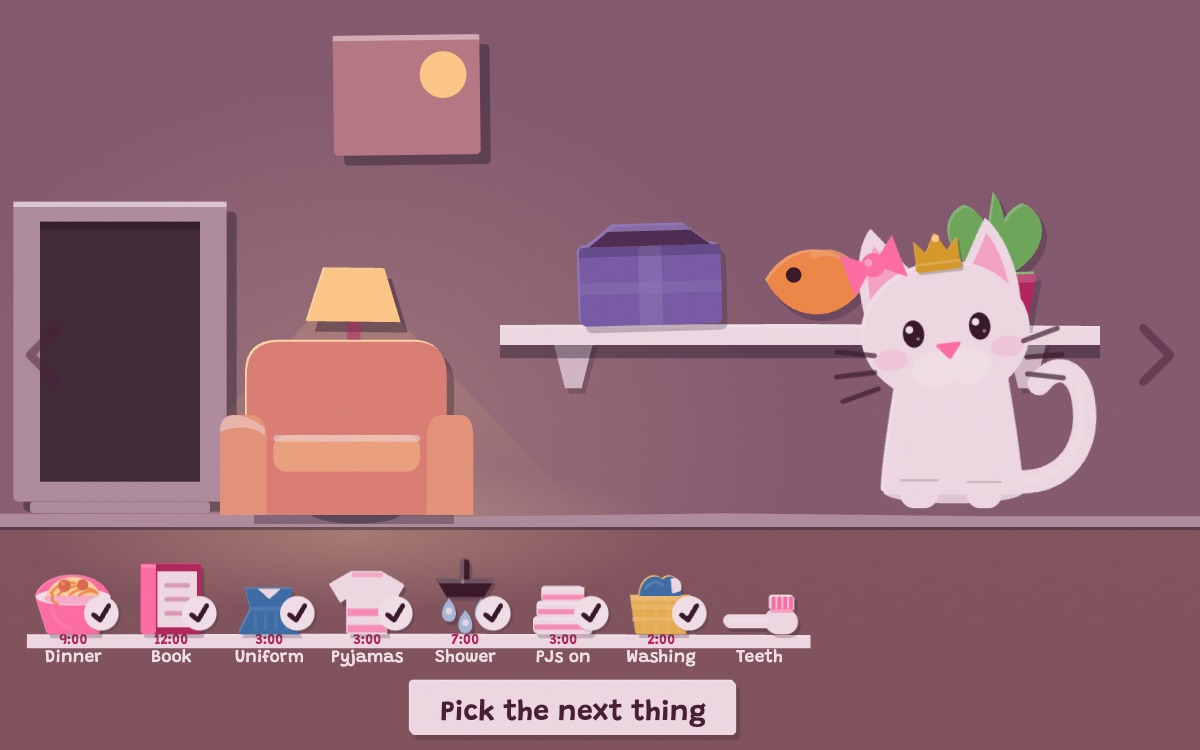
The lamp comes on at eight. Seven of the eight done.
Bedtime
Tilly's asleep, and the bedroom shelf is full. The point of all of it is that I stop saying “right, next one”.
She picked the colours
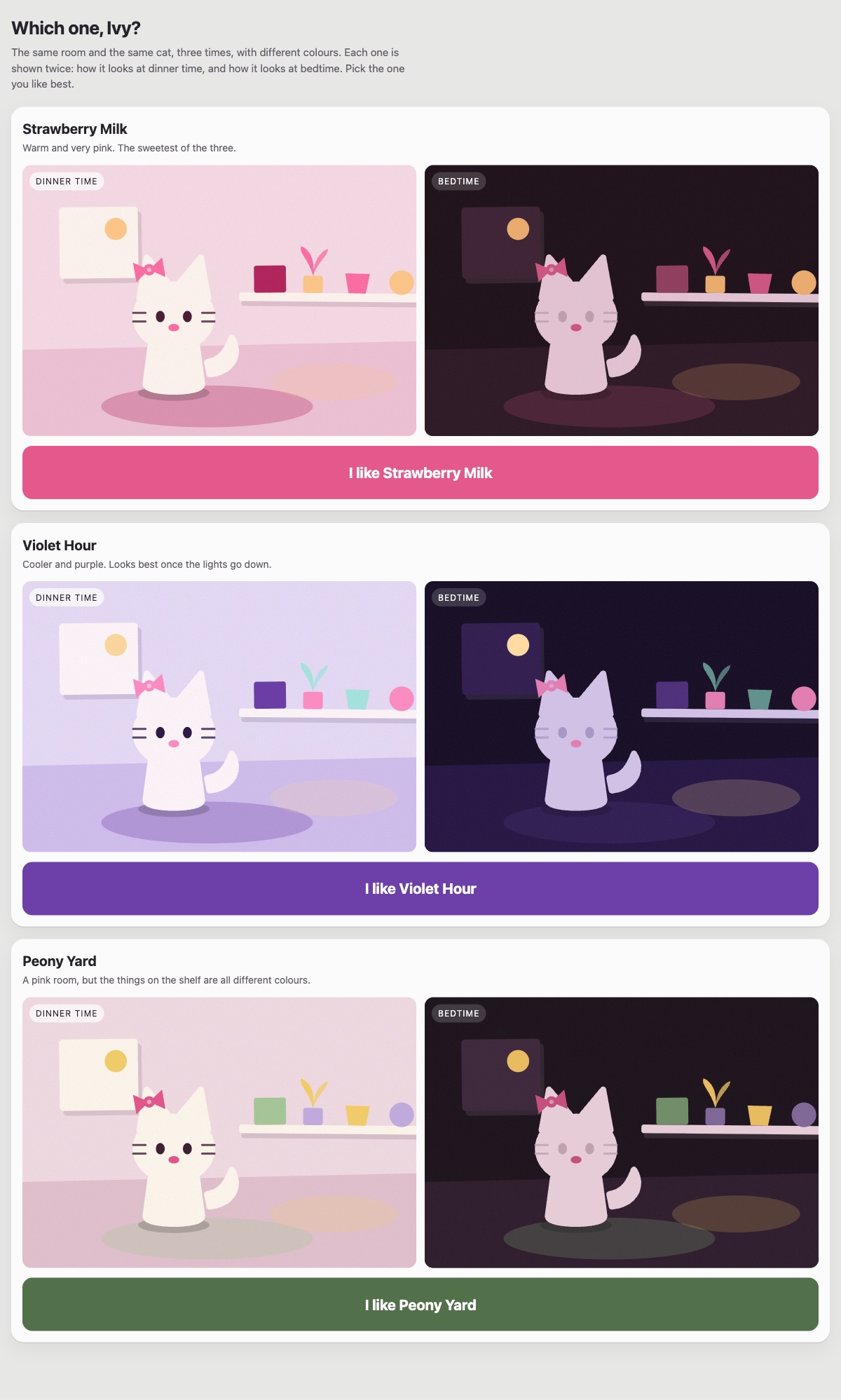
I put three palettes on one page, each shown at dinner time and at bedtime, and asked her which one. She chose Strawberry Milk over Violet Hour and Peony Yard.
She's been using it on real school nights since the middle of August, and the first one turned up eight things to fix.
Sydney, so AEST. If you're in Europe or the US, the reply will land overnight.
Cake Orders
In daily use at Cake.Biz
Paper stays in charge at my in-laws' cake shop
My in-laws run a cake shop called Cake.Biz. Orders came in on paper and lived in a folder, which was fine right up until somebody needed to know what was due on Saturday.
I was careful not to change how they work. The same form still gets filled in by hand at the counter, a model does the typing, and on the morning of the pickup the order comes back out as paper on the bench.
Handwriting in, paper out
Paper · at the counterThe form, filled in by hand
It's the same form as always, in whatever handwriting turns up that day, and once it's filled in it gets photographed.
Screen · straight afterA model reads it into fields
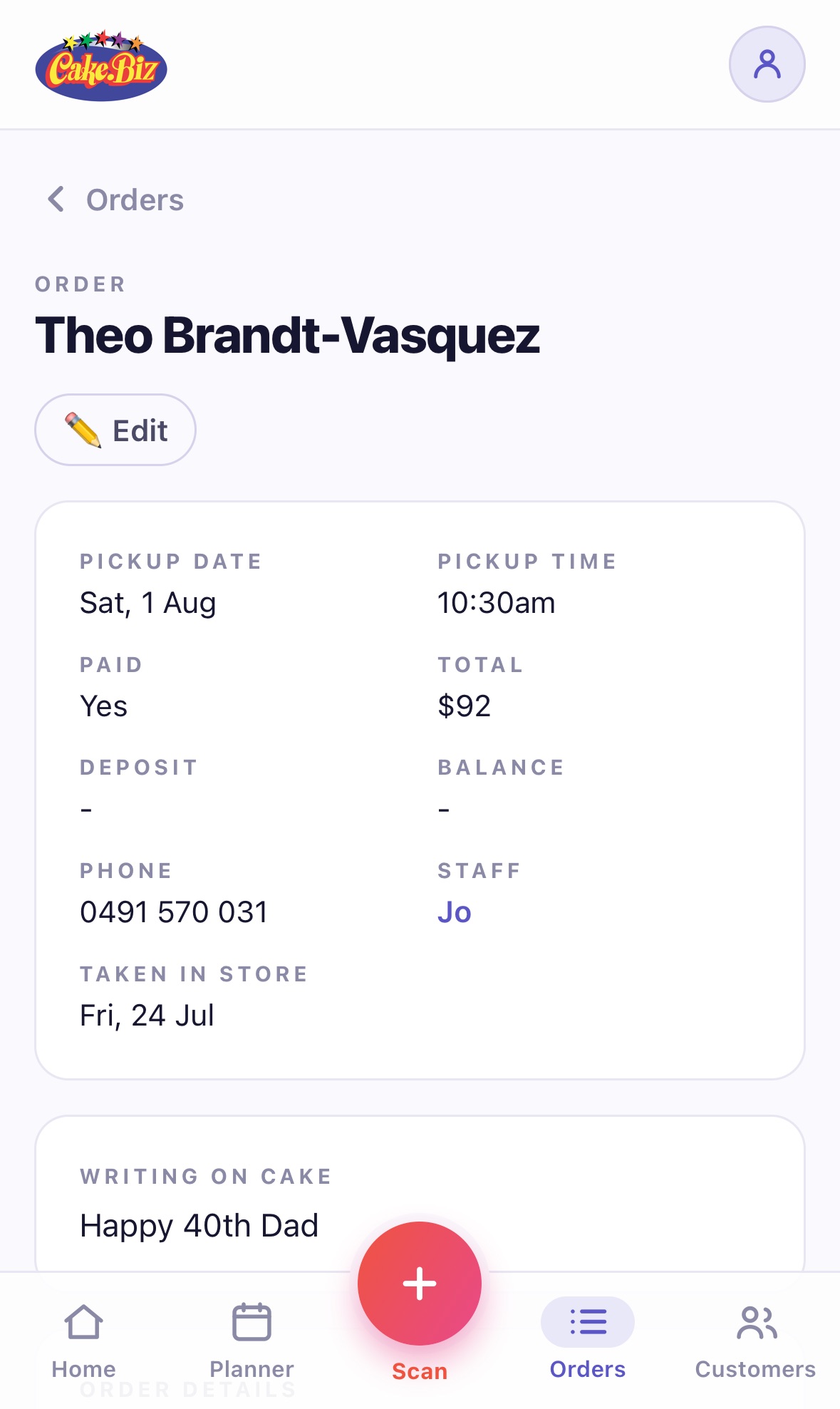
It picks out the name, phone, pickup and the cake itself, and staff check each field against the photo before they save, with the photo kept alongside the order. On this one the model read 8″ as a plain 8, which is the kind of slip the check is there to catch.
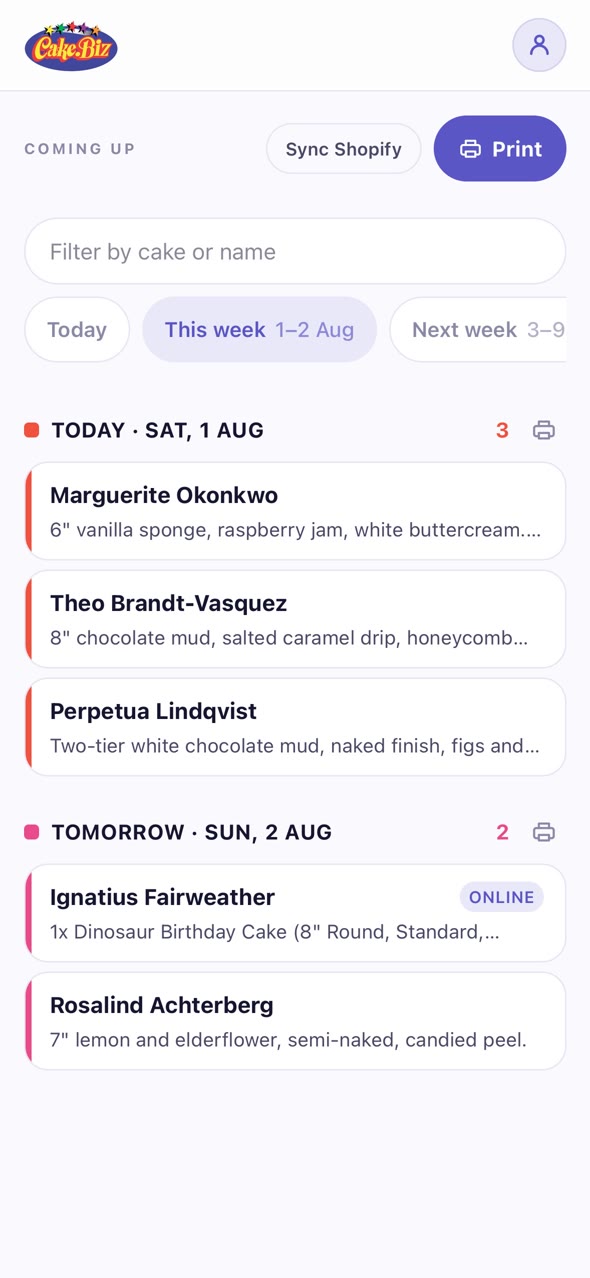
Screen · all weekEverything due, grouped by day
Orders from their Shopify store land in the same lists, marked Online, so the counter and the website end up as one list of cakes to make.
Paper · the morning ofOne run sheet for the day
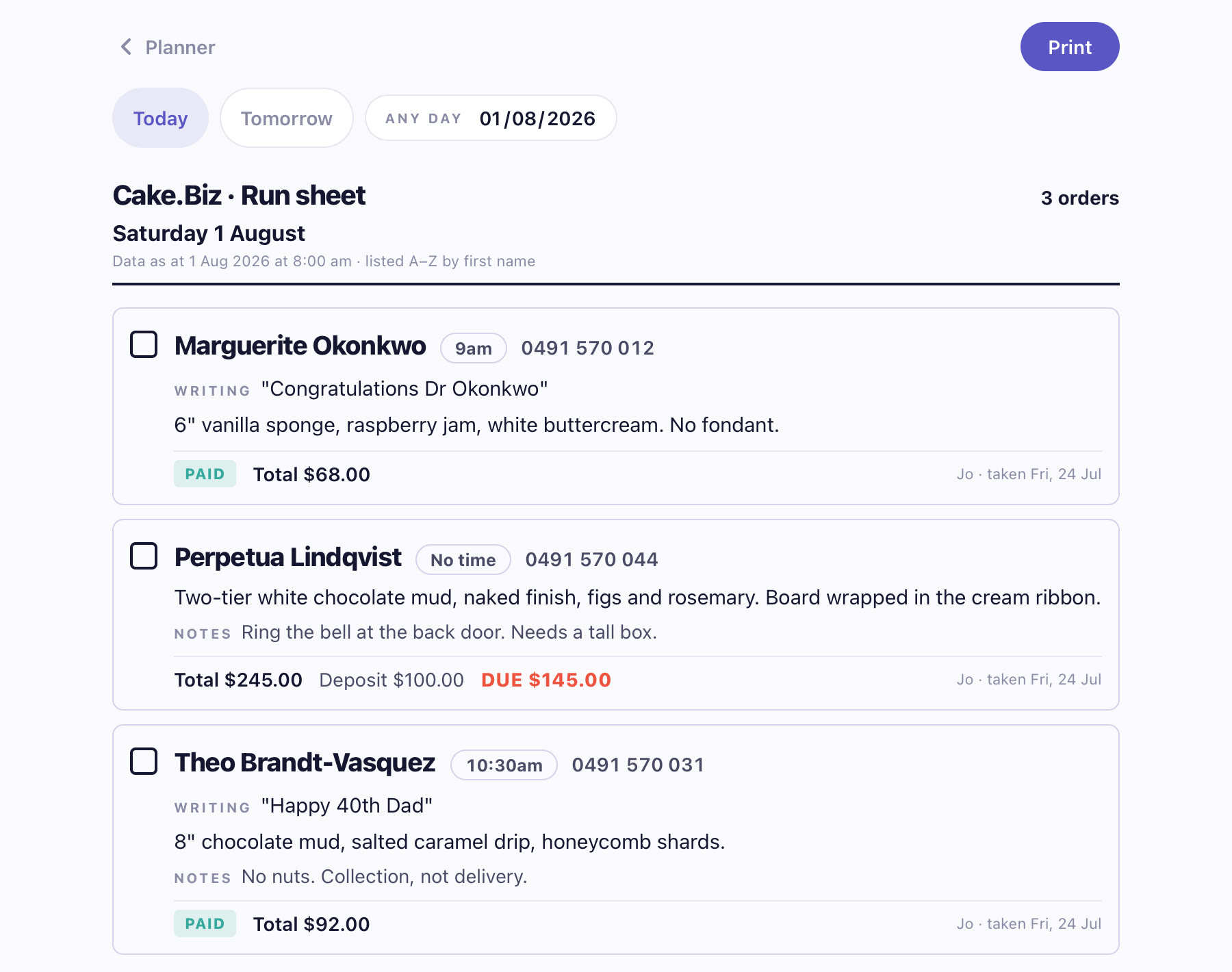
A to Z by first name, a box to tick with a pen as each cake goes out, any money still owing in red, and a stamp saying when the data was pulled.
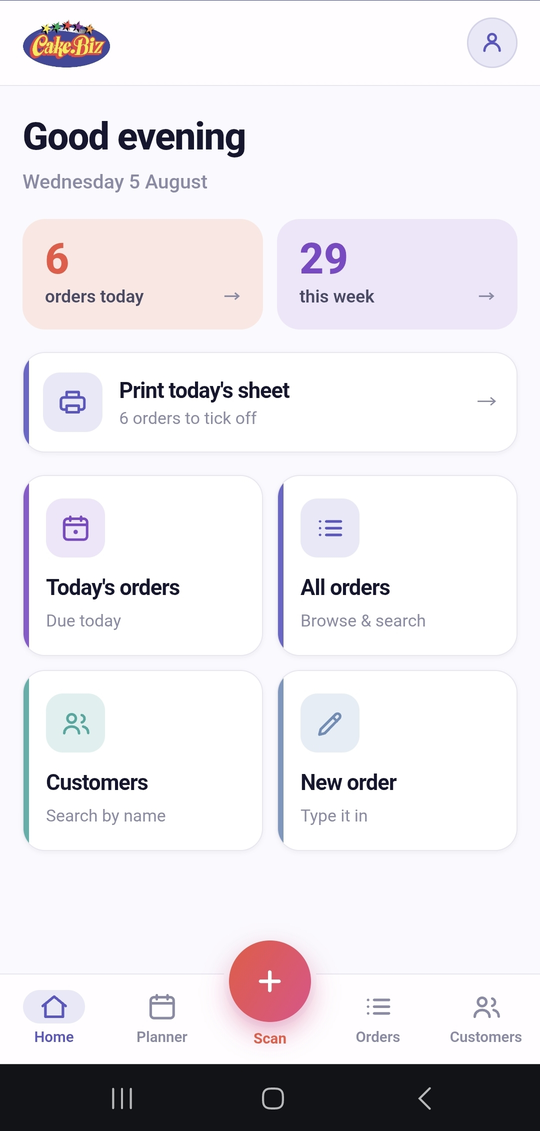
An invented order on real screens. The handwritten 8″ and the 8 read back from it are the same order.
Details that matter at a counter
The home screen is the whole app at a glance: what's due today and this week, the day's sheet ready to print, and a way into every order and customer.
The run sheet refuses to print if the orders failed to load, so nobody gets handed a blank page that looks like a quiet day.
Shopify flows one way, into the app: new online orders come through whenever the app opens, there's a Sync button for in between, and the first run went back 90 days.
Every customer has a record, and search covers names and cake descriptions, so an order from months ago is a few letters away.
The shop runs hundreds of orders a month through it.
Competitive research where every line says whether it was seen or guessed
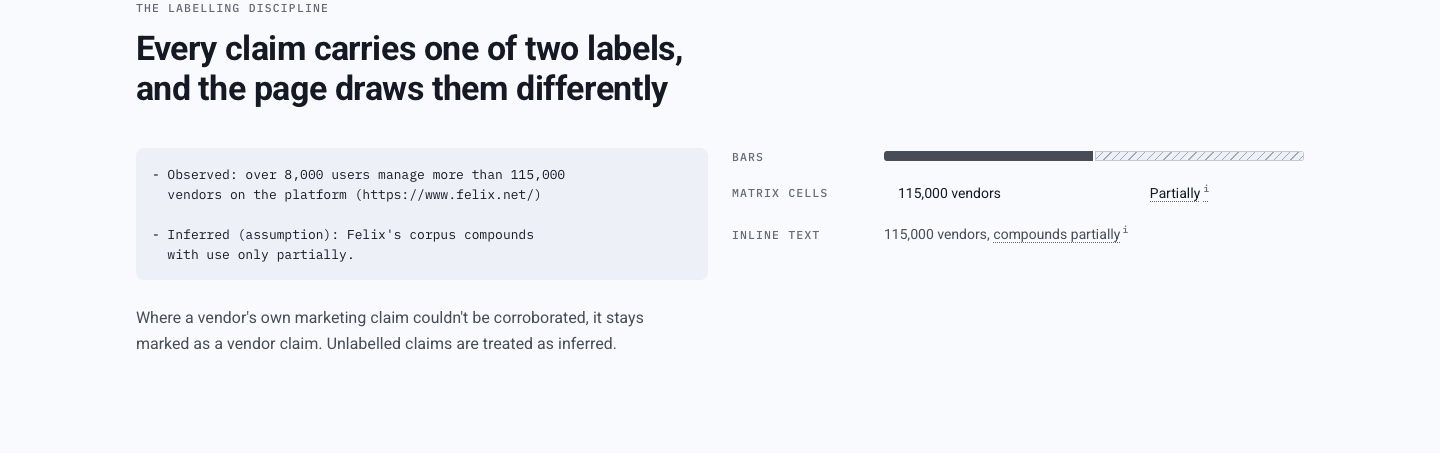
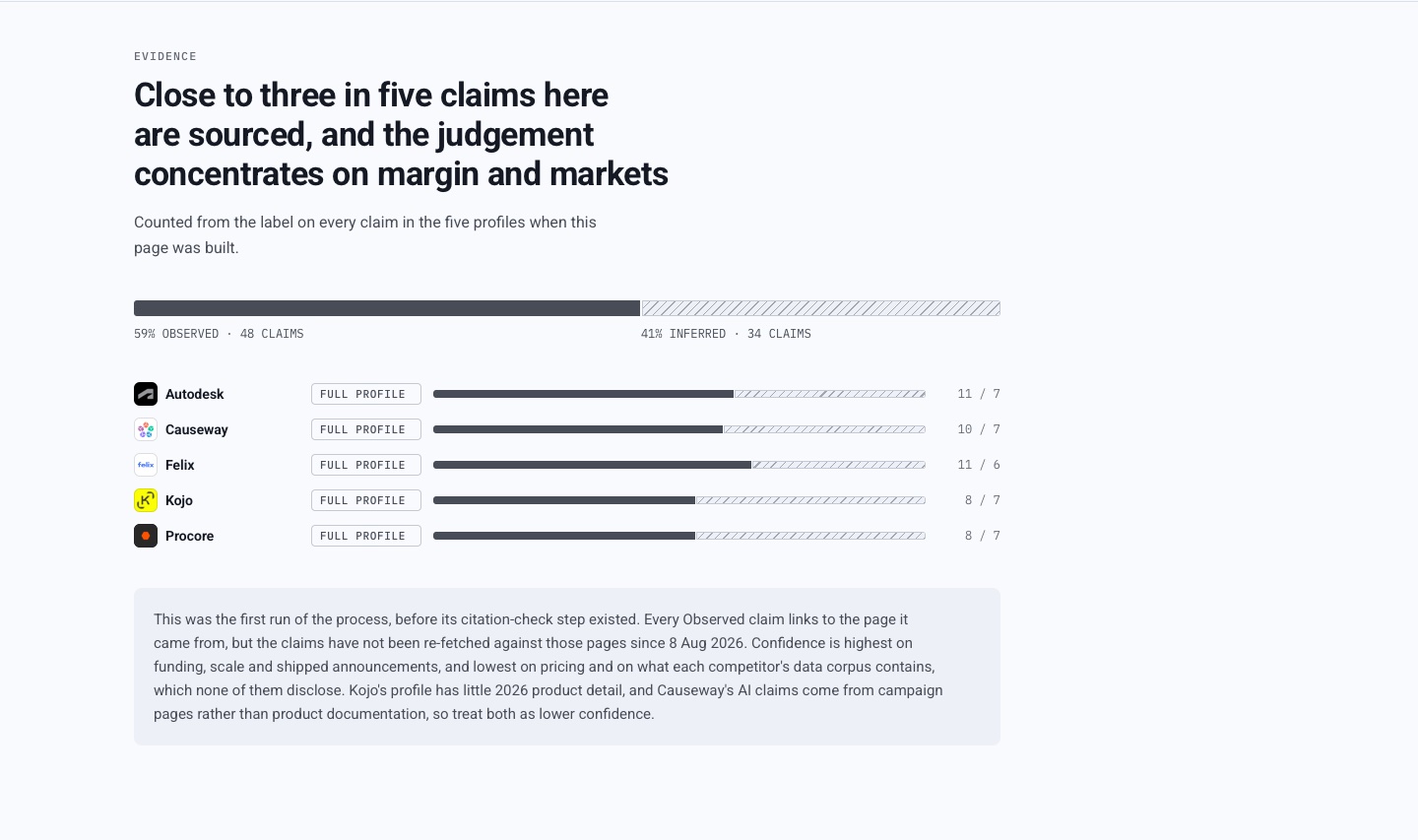
The reading is the part I could never keep up with, so the tool does it. Every line it writes is labelled Observed, with the page it came from, or Inferred, so a confident guess can't pass as fact.
A run on ProcurePro, dated 8 August 2026. The meter at top right says how far to trust the rest of the page. Open the whole page
One working session, start to finish
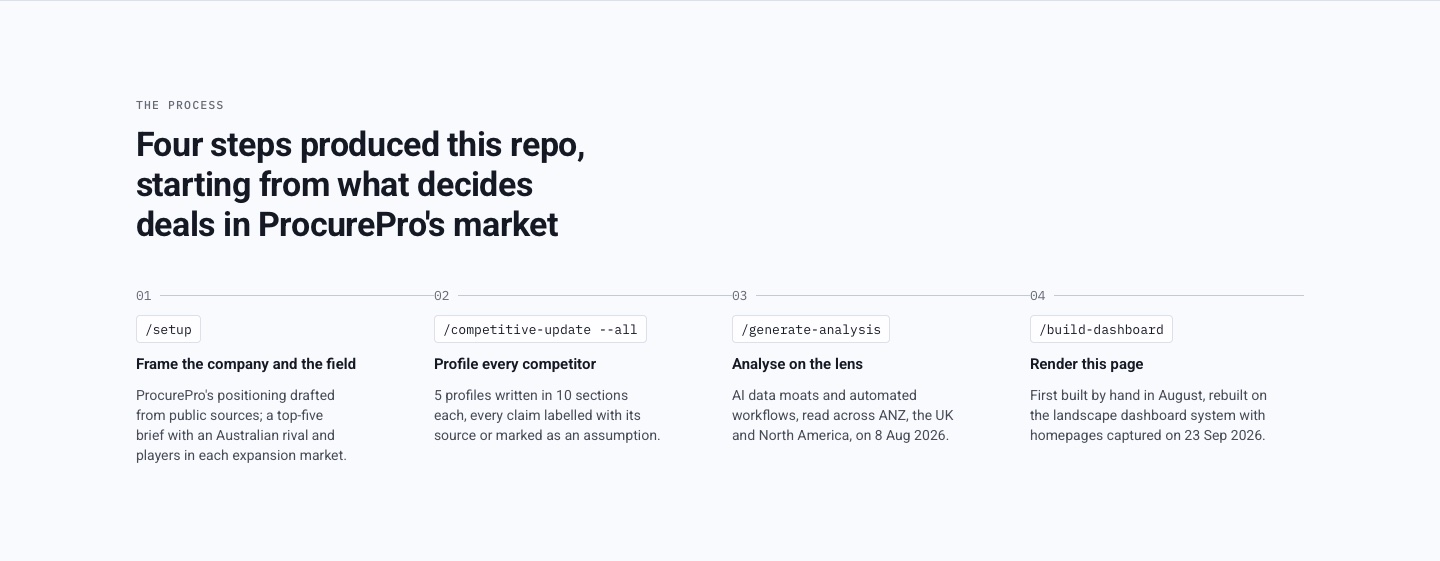
1You
Give it the company, a lens to read the market through, and who to watch. For ProcurePro the lens was AI data moats and automated workflows.
2/setup
Drafts the company's positioning from public sources and proposes the competitors worth watching.
3/competitive-update --all
Works through the competitors in batches and writes a profile for each, ten sections long, with every claim labelled.
Two claims as the profile writes them, and how the page draws each one.
+Citation checkAdded since this run
Re-fetches every URL a claim cites. A claim only passes if that page holds a verbatim quote for it, and one that fails is downgraded to Inferred where you can see it.
4/generate-analysis
Writes one analysis across all of them, read through the lens.
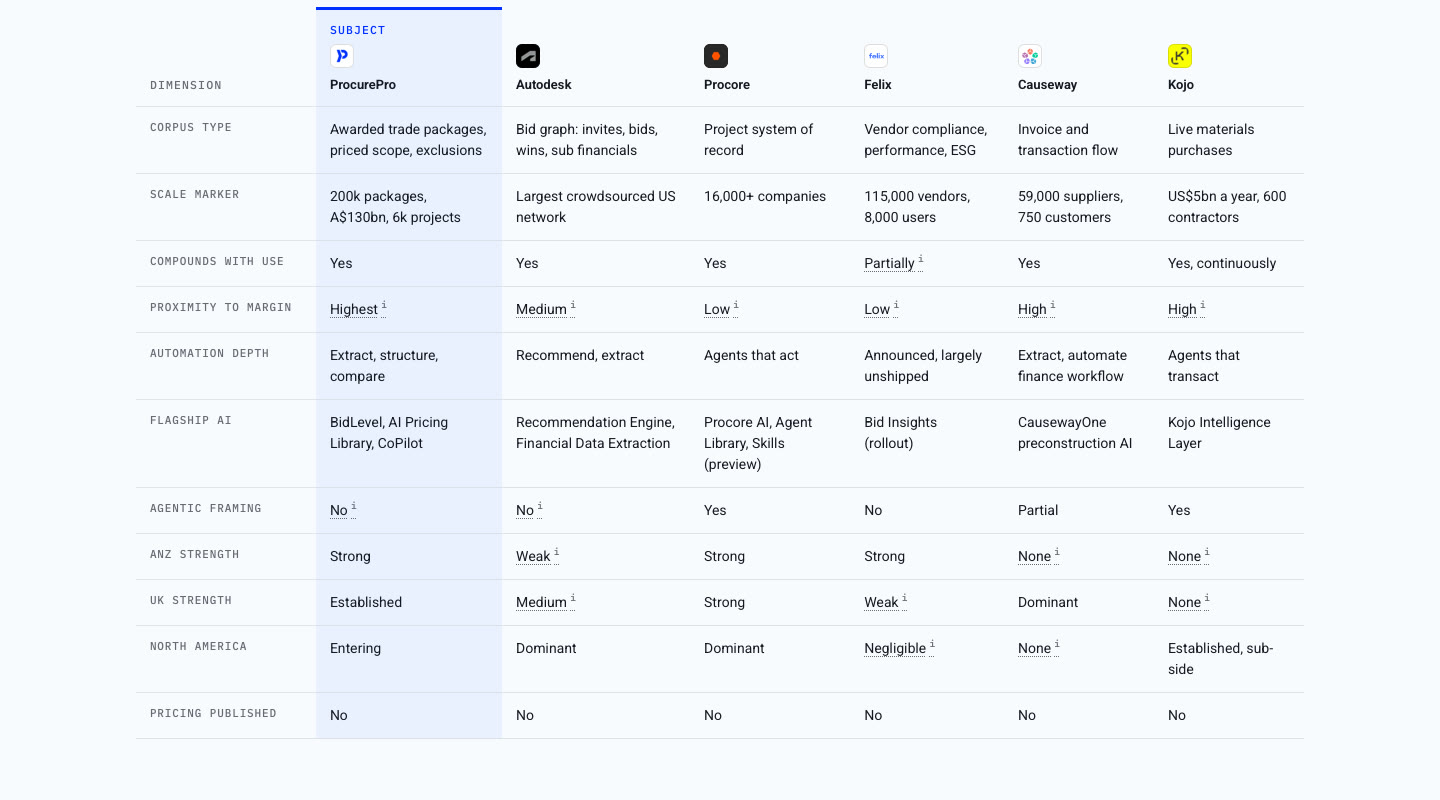
Part of the output: six companies side by side on the same rows.
5/build-dashboard
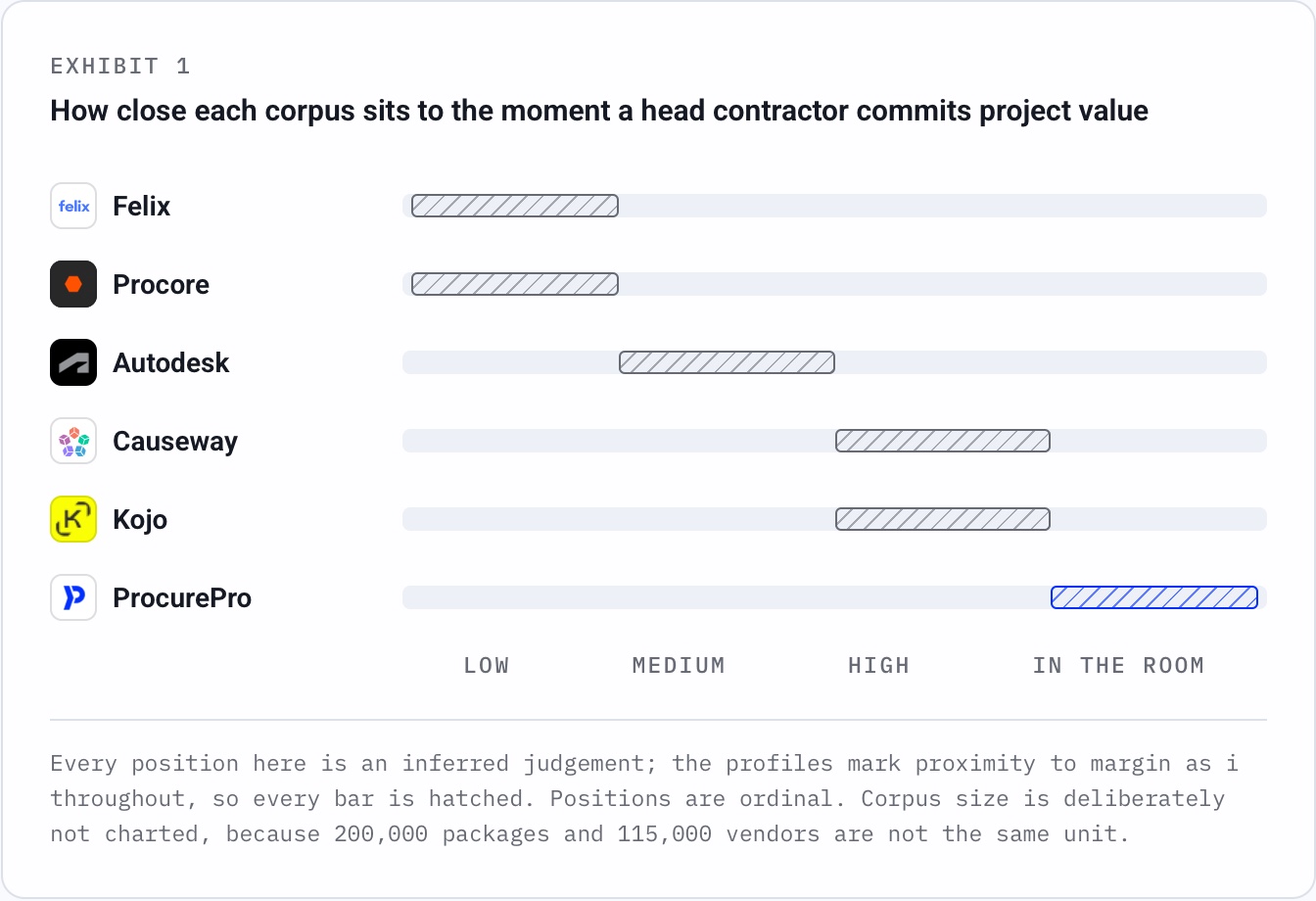
Renders the page at the top of this sheet, with a chart behind each finding.
Exhibit 1. Every bar is hatched, because each position is a judgement the profiles mark as inferred.
The page tells the story of its own run, too.
What the ProcurePro run came back with
Competitors, all profiled in full
5
Sections per profile
10
Labelled claims
82
Observed
59%
Markets read
ANZ, UK, North America
Time for a full profile
A few hours
The evidence section says plainly that this run came before the citation check.
The guesses are where I spend my time. Happy to hand it over, too: email me your GitHub username and I'll share the repo with you.
A Warcraft III map from 2005, rebuilt in the browser out of its own file
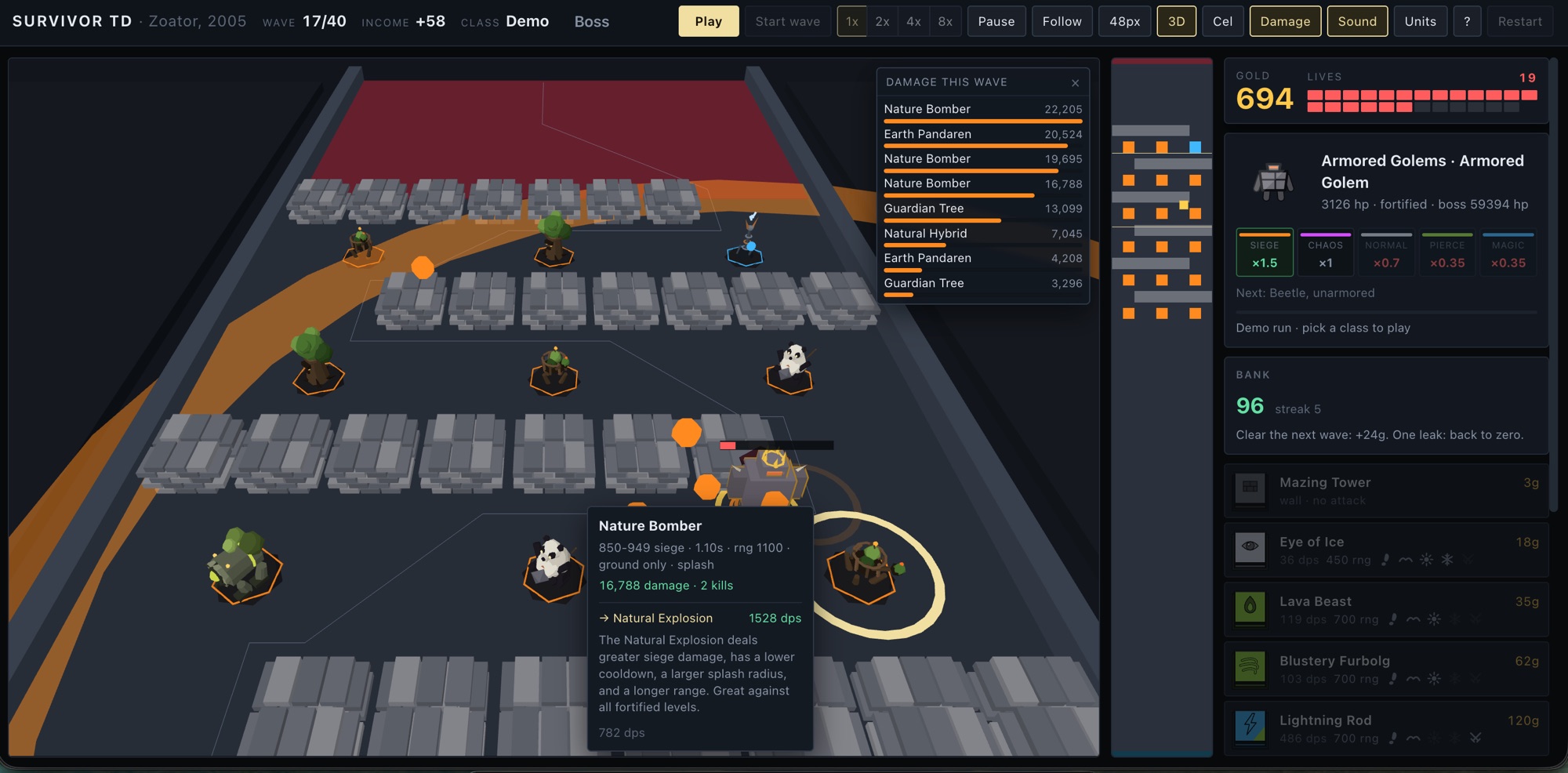
Pure hobby, this one. I spent most of my teens playing custom Warcraft III maps, there's one I wanted to play again, and getting a game going is basically impossible now. So I've been rebuilding it in the browser.
The data turned out to be the hard part. Every wiki about this map disagrees with every other wiki, and the ones that agree are copying each other. The original map file has the real numbers sitting inside it, so the game gets built from the file itself.
Map file in, game out
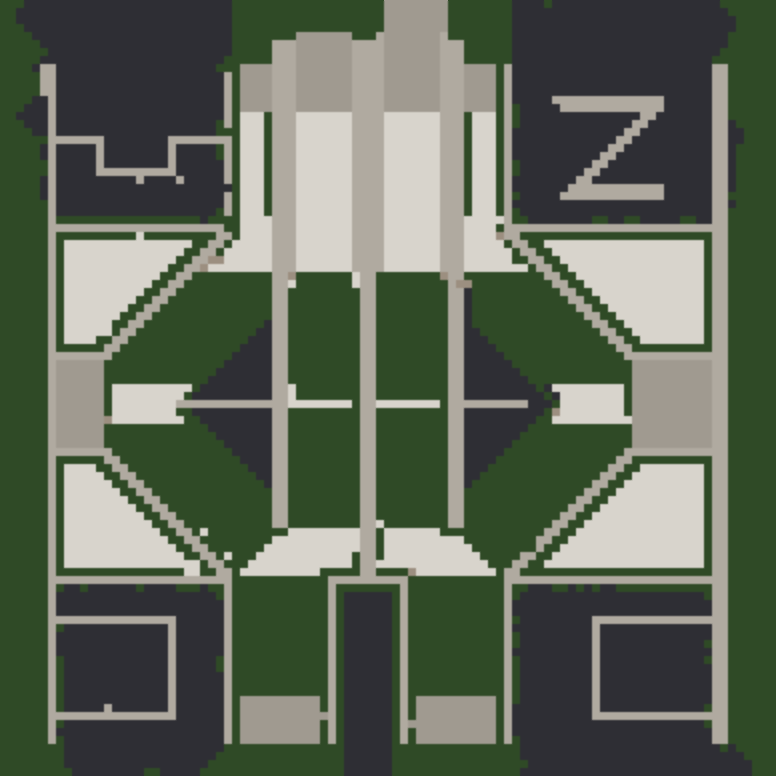
1 · The map
The 2005 map's terrain, drawn straight out of the archive.
2 · The data
The .w3x map is an MPQ archive
Python tools open it and parse the binary unit tables
They write it all out as JSON
gen_content.py builds content.json
The game runs on content.json
Nothing is hand-copied.
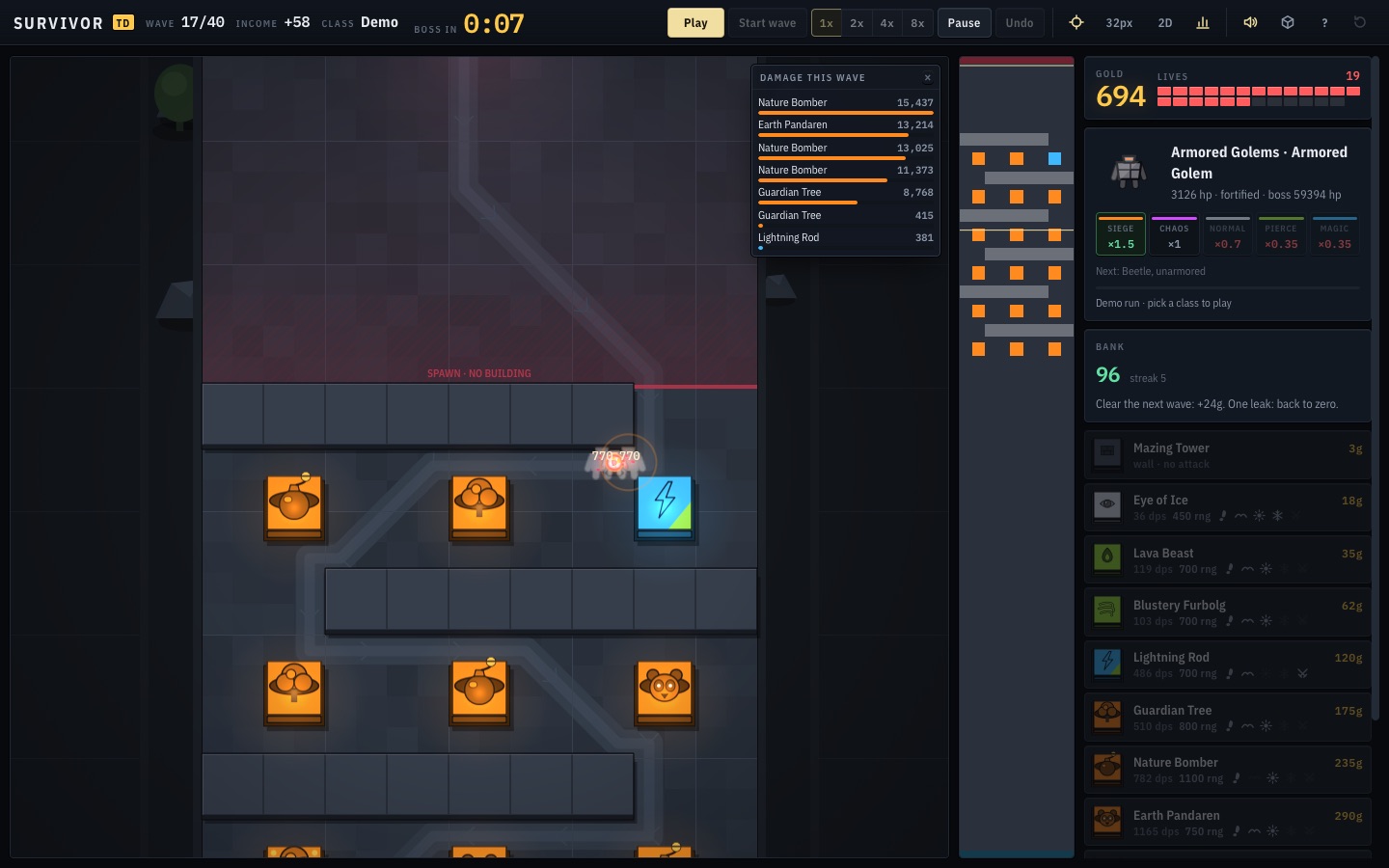
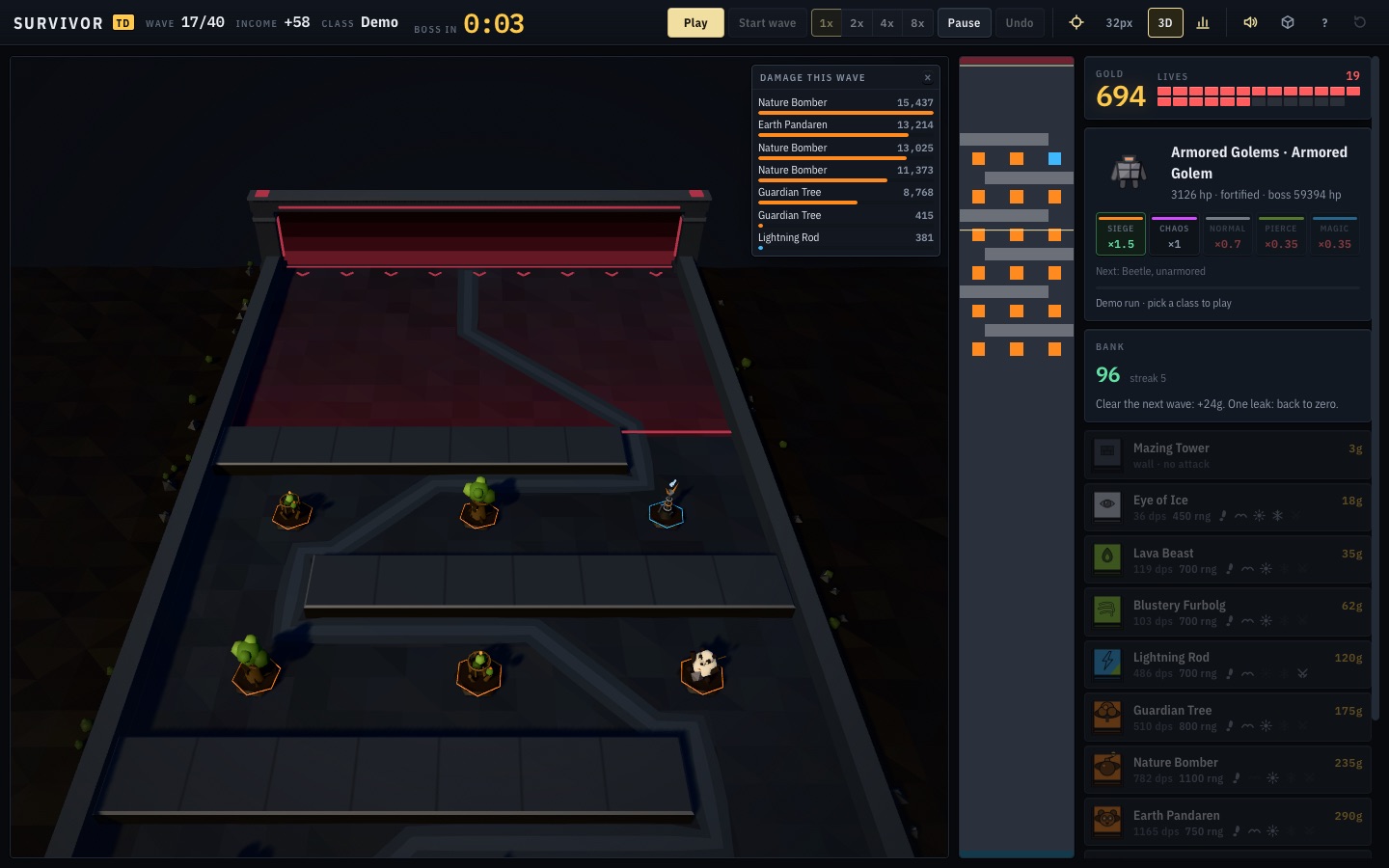
3 · The game
2D3D
The same board in 2D and 3D, with this wave's damage, the creep's armour multipliers and the tower shop down the side.
What came out of the file
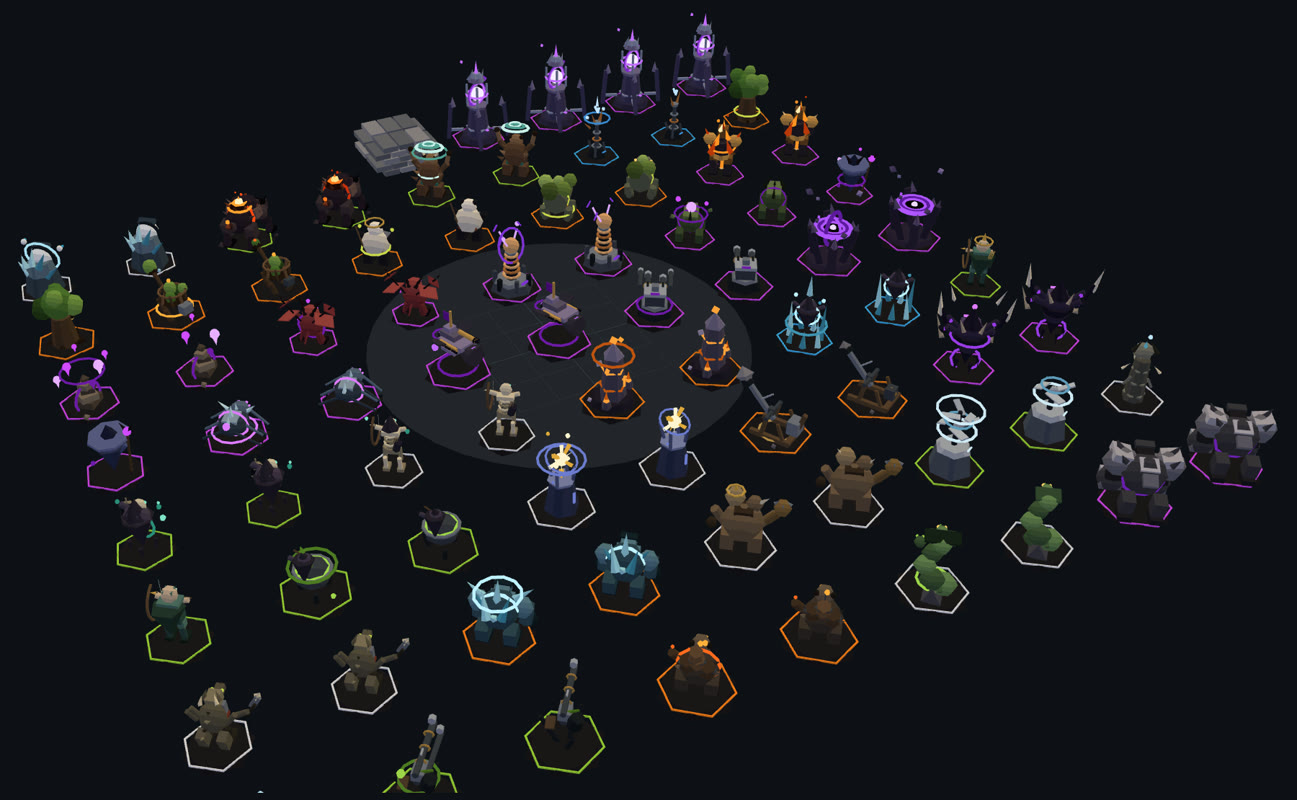
73towers
80creeps
40waves
4classes
Each wave is a normal creep and a boss.
Every tower on the turntable, rendered from the same data the game uses.
Two things the file taught me
A decrypt library was silently dropping the trailing bytes off what it read.
Asking the archive for war3mapMisc.txt by name turned up 647 bytes of damage-table overrides that I'd assumed were stock.
The people I want to still be talking to in twenty years
A close group of people I respect, from a wide range of disciplines, who I want alongside me for the rest of my career. We talk about what we're each working on, help out when somebody's stuck, and share what we're learning and seeing, so all of us get ahead sooner.
It started with eight to ten people and it's picking up as it goes. Every invite is a vouch.
A fortnight in the Guild
Week oneWeek twoMTWTFSSMTWTFSS
The TavernTuesday, 9 to 10pm SydneyShow, tell, shit talk. No agenda.
In between, a light “what are you stuck on?”then the Tavern again →
The Tavern is the one ritual, every second Tuesday from 9 to 10pm Sydney time, with no agenda. Between Tavern nights there's a light prompt asking what everyone's stuck on.
Mostly I build in the open there, posting what I tried and what broke, which turns out to help more than advice does.
I set this up sitting next to people, and it ends up shaped like them
The way I help people with this is to sit down with them, build their version together, and stay close while they get comfortable with it. We're scaling it across the product team at work, with AI as the leverage, and outside work I've set it up with close contacts, one at a time.
Everybody's version ends up different because it's encoding how that person already works. So we start with what they do now, in the order they do it, and write that down before any of it goes near an agent.
How I go about it
My penTheir pen
1Sit down
We start with the work in front of them this week.
2Map how they work
What they already do and the order they do it in, including the steps that only live in their head.
3Write the steps down
The only thing that transfers is writing the steps down, so they get written in their words.
4Run it together
Then comes watching the first few runs closely. I sit alongside for those, and we fix what breaks as it breaks.
5They take the wheel
They run it and change it, and it starts to look like theirs.
6It scales out
The next person starts from their own work, and it grows one person at a time.
How I approach it, drawn as a sketch. The bar under each step shows roughly who's doing the writing at that point.
What mine looks like
Mine is nine specialist agents, each with its own role and its own private memory, working from a shared context file and six streams files that feed a dashboard. Coding plans get reviewed by the engineer agent before anything is built, and anything written for other people goes through a writing-voice checker.
Yours would come out looking different, which is the point.
Your turn
If you're working out how to get AI doing real work for you, I'd like to sit down and set yours up together. Tell me a bit about how you work now and we'll start from there.


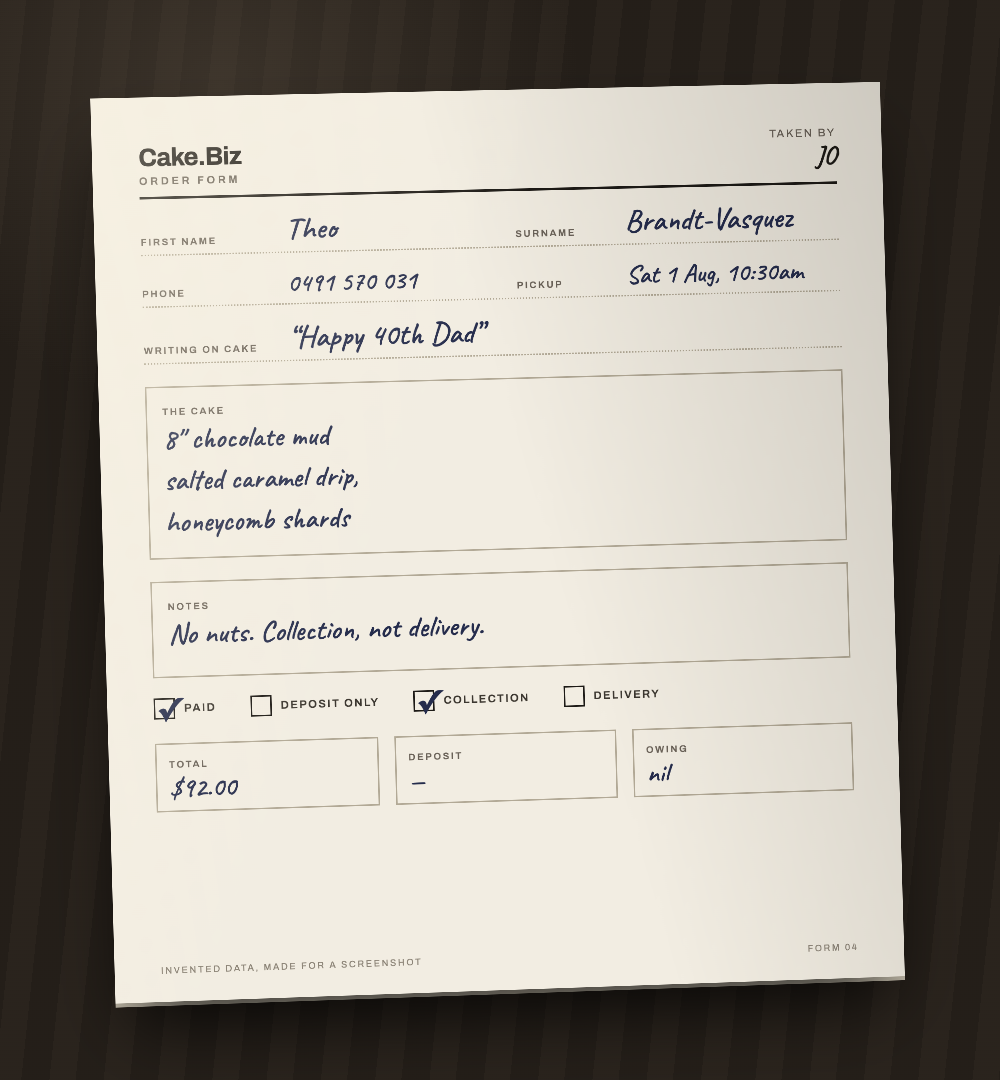 Paper · at the counterThe form, filled in by hand
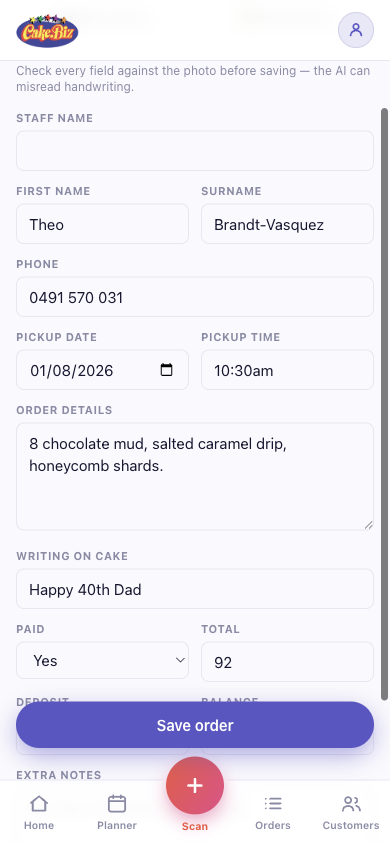 Screen · straight afterA model reads it into fields
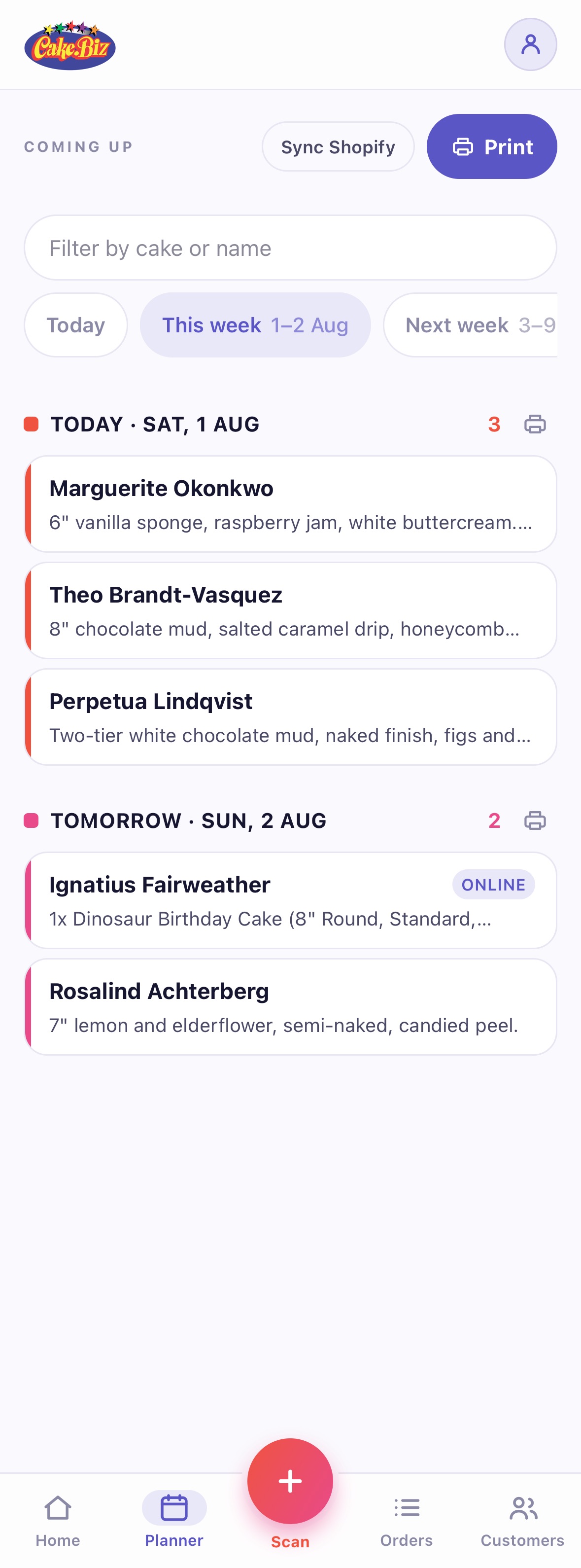 Screen · all weekEverything due, grouped by day